Contract Lifecycle Management
CLM Software for Post-Signature Intelligence
The era of the ‘Digital Filing Cabinet’ is over. If your CLM software waits for you to search for a problem, it is already too late. Brooklyn replaces the passive repositories of the past with an active Intelligence Layer. Unlike generic tools that consider the job done at the signature, our contract lifecycle management platform is engineered to police the lifecycle, auditing performance, flagging risks, and ensuring that the operational reality matches the contractual promise. Don’t just store your data; operationalise it.
Why Traditional CLM Tools Fail the Enterprise
Most CLM software is built for Legal (Drafting), not for Business (Managing). Once you sign, those tools become nothing more than expensive cloud storage.
-
The “Repository Trap”: Your current software hides data in unsearchable PDFs.
-
No Active Monitoring: Traditional tools wait for you to search; they don’t alert you to risks.
-
The Integration Gap: They fail to connect legal promises with finance realities (Invoices vs. Rate Cards).
Brooklyn Solutions is different. We are the “System of Intelligence” that sits after your e-signature tool to manage the lifecycle that matters: The Performance Lifecycle.
Post-Signature: Oversight, Fulfilment, and Renewal
Once a contract is executed, the risks change dramatically. The contract becomes operational, triggering obligations, compliance requirements, and renewal timelines. Unfortunately, many organisations lose visibility at this point, especially when contracts are stored as unstructured PDFs or buried in shared drives.
Post-signature CLM focuses on actively managing:
-
Contractual obligations and milestones
-
Regulatory and policy compliance
-
Contract variations and amendments
-
Strategic and tactical renewals
-
Evidence for audit, assurance, and reporting
This phase requires more than storage, it requires structured oversight and governance. Without a framework in place, contracts become silent risks: auto-renewing, unmanaged, or non-compliant.
Brooklyn’s Post-Signature Capability
Brooklyn supports contract lifecycle management by focusing on what happens after contracts are signed, when obligations, compliance requirements, and operational risk begin to materialise.
Executed contracts are centralised and enriched with structured data so key dates, obligations, and commitments remain visible throughout the contract’s operational life. This enables organisations to move away from reactive contract management and towards continuous, governed oversight.
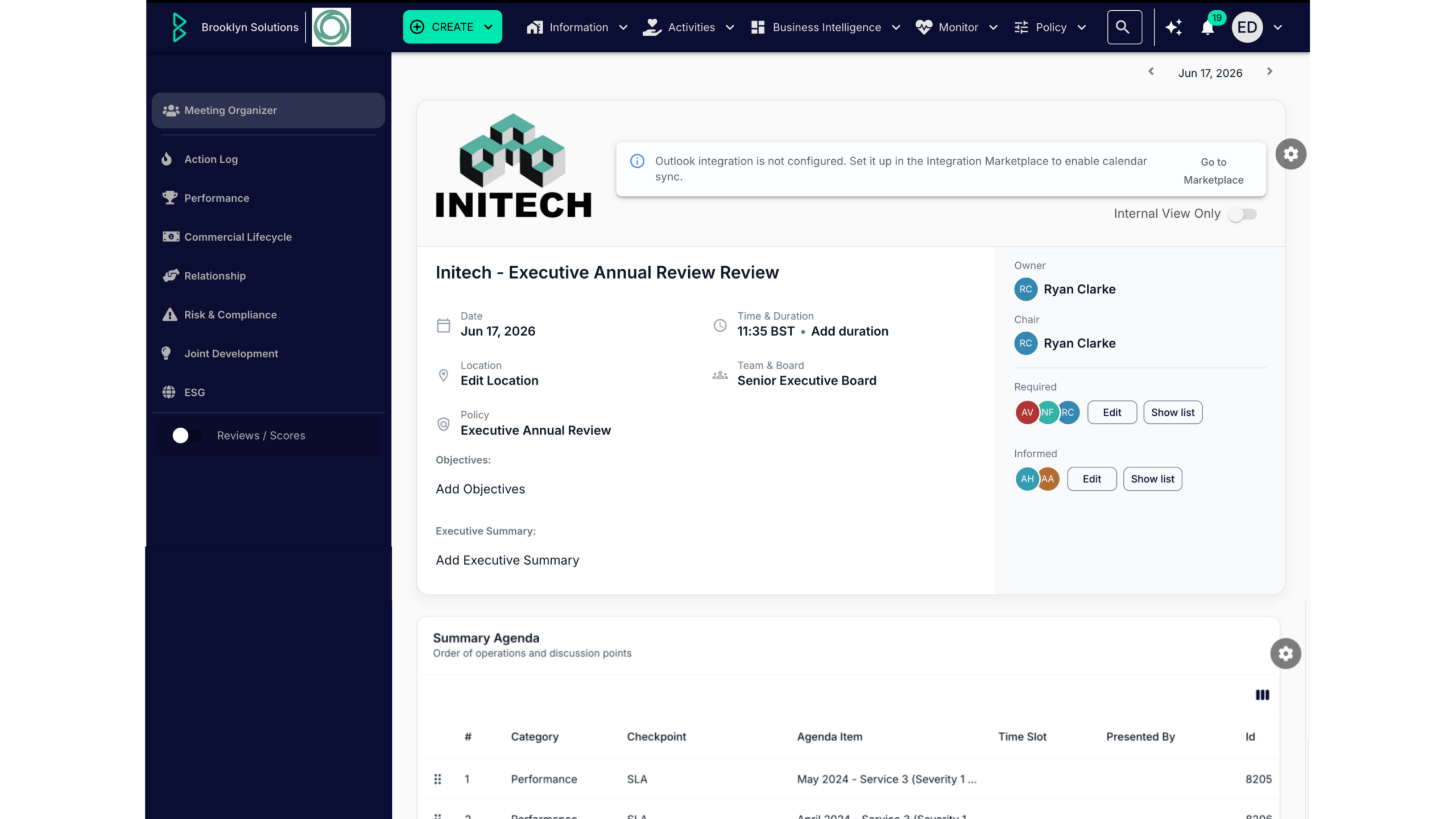
Brooklyn applies structure and consistency to post-signature contract management. Amendments, variations, and renewals are handled through controlled workflows rather than informal processes, ensuring changes are reviewed, approved, and auditable. This reduces reliance on individual knowledge and improves consistency across teams.
Technical Specification: Brooklyn Agentic AI Core
| Feature Capability | Technical Methodology | Autonomous Output / Governance Action |
| Ingestion & OCR | Multi-engine Vision (RAG 2.0) | Contextual layout analysis; detects missing signatures/illegible clauses. |
| Metadata Extraction | Named Entity Recognition (NER) | Auto-population of: Counterparty, Effective Date, Liability Caps, Governing Law. |
| Obligation Tracking | Semantic Reasoning Agents | Autonomously triggers reminders in ERP/Slack for delivery milestones. |
| Regulatory Alignment | Dynamic Framework Mapping | Real-time gap analysis against DORA, ESG (CSRD), and GDPR standards. |
| Risk Scoring | Logic-Based Pattern Matching | Flags “Above Playbook” indemnification or high-risk termination clauses. |
| Integration Layer | Model Context Protocol (MCP) | Bi-directional data sync with SAP, Oracle, and Salesforce without manual APIs. |
How Brooklyn Enables GRC Through Contracts
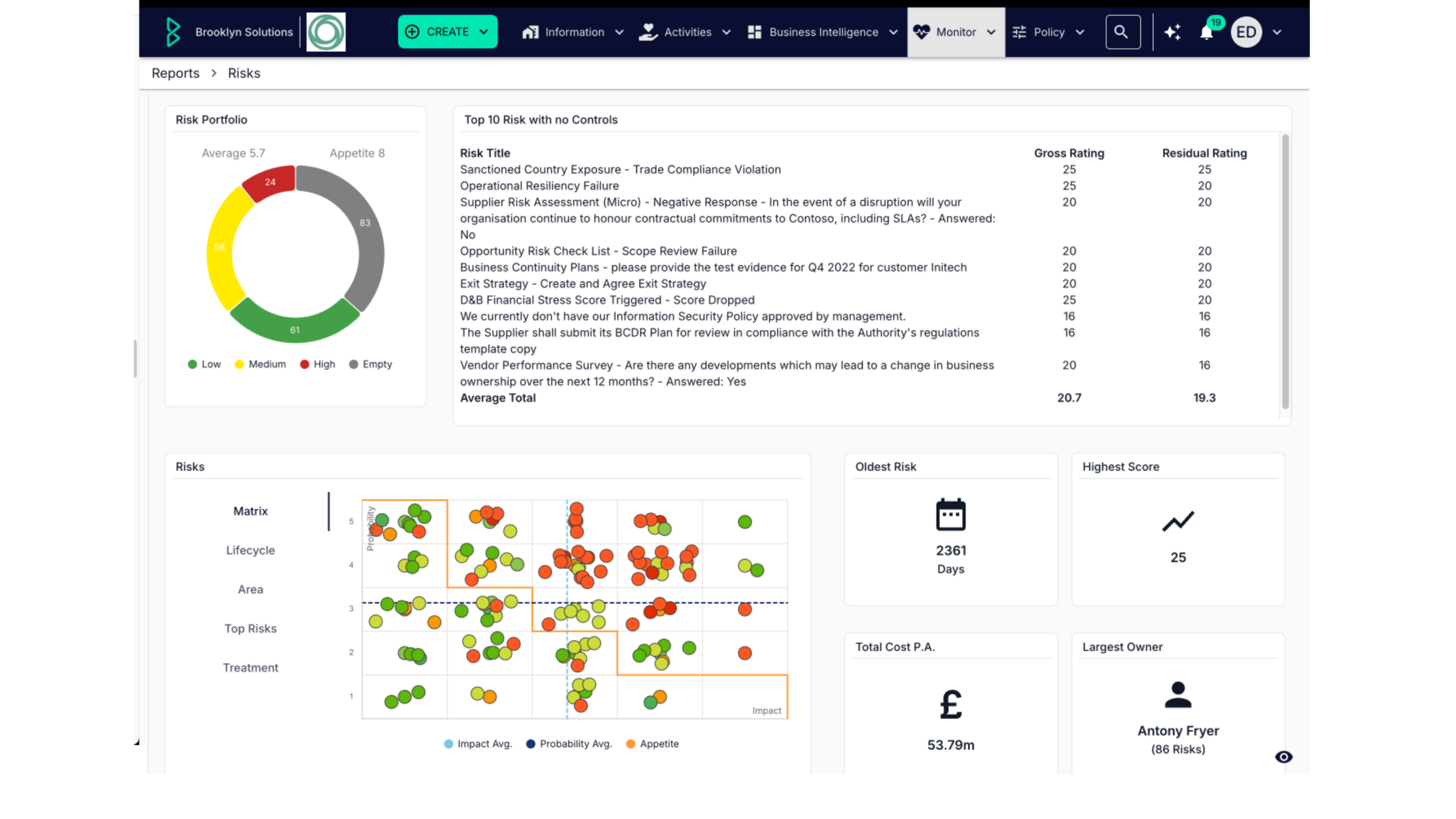
A defining aspect of Brooklyn’s CLM capability is its integration with governance, risk, and supplier management. Contracts are not managed in isolation, but linked to the suppliers they govern, the risks they introduce, and the compliance requirements they support.
This integrated approach provides organisations with a clearer, more defensible view of contractual exposure across their third-party and regulatory landscape. Rather than treating contracts as static records, Brooklyn enables them to function as active controls within broader governance frameworks.
Brooklyn’s post-signature CLM platform capability is designed for organisations where assurance matters, particularly in regulated environments. By providing traceability, audit-ready evidence, and ongoing oversight, Brooklyn helps ensure contracts remain compliant, controlled, and aligned with governance expectations throughout their lifecycle.
How CLM Software Improves Control and Visibility
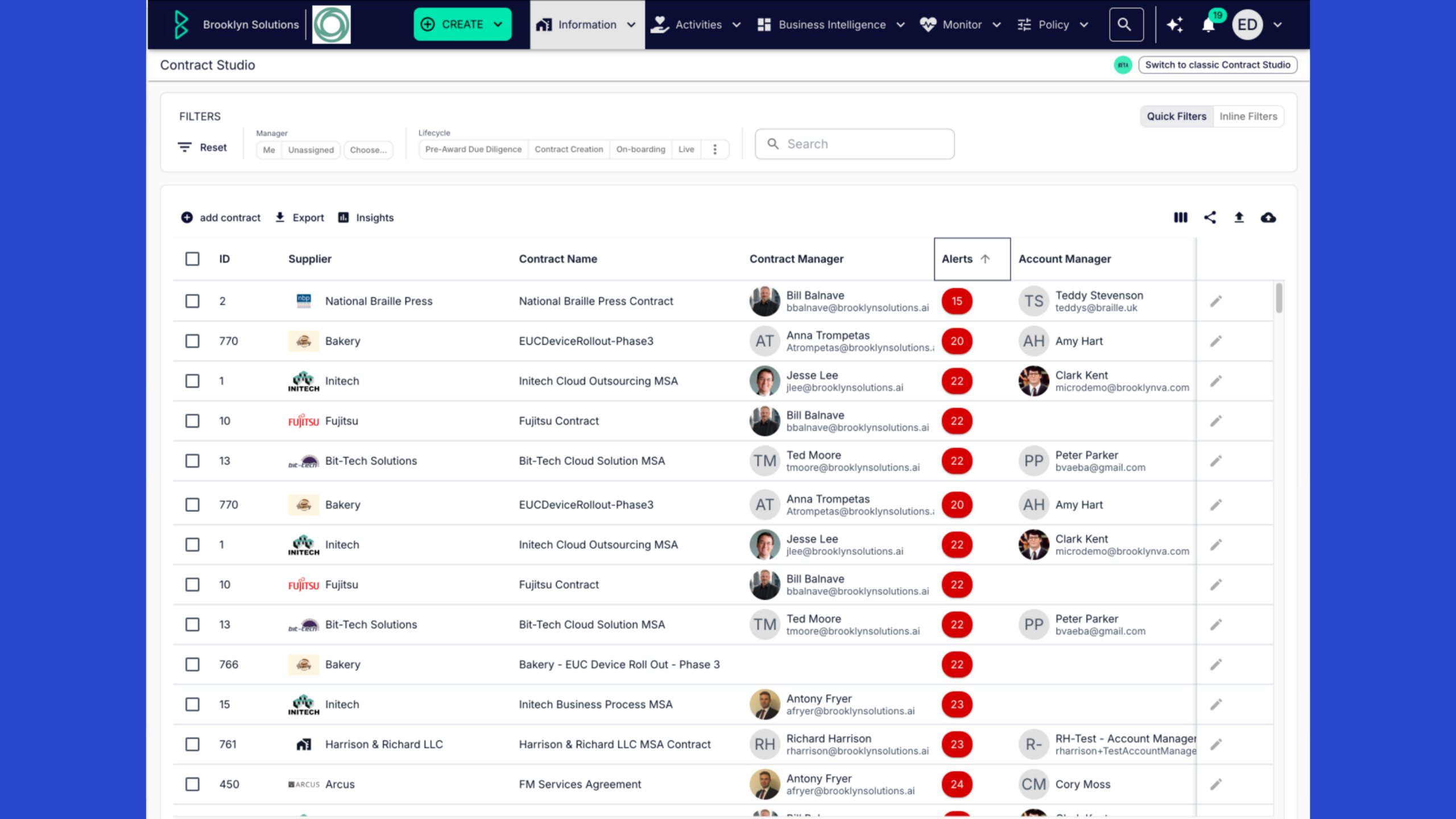
The primary value of CLM software lies in its ability to make contracts visible and manageable over time. By structuring contract data and applying workflow controls, CLM software reduces reliance on manual intervention and informal tracking.
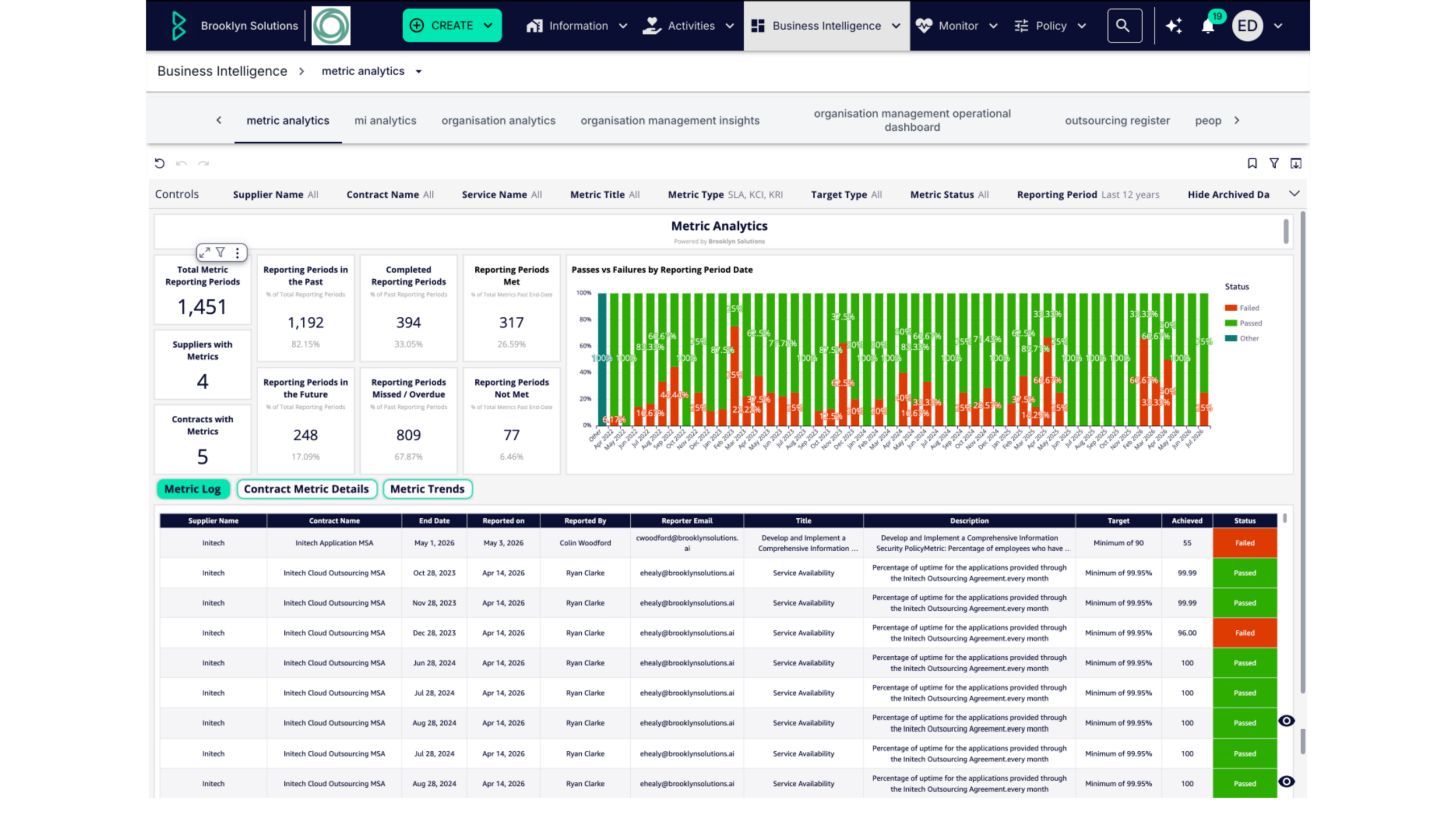
Obligations can be monitored proactively rather than reactively. Amendments can be reviewed and approved through defined processes. Renewals can be evaluated with sufficient notice and context. Collectively, these capabilities reduce risk and improve decision-making.
Importantly, CLM software also provides an auditable record of activity, which is increasingly important in regulated industries and during internal or external reviews.
From Passive Storage to Agentic Contract Intelligence
The Agentic Advantage
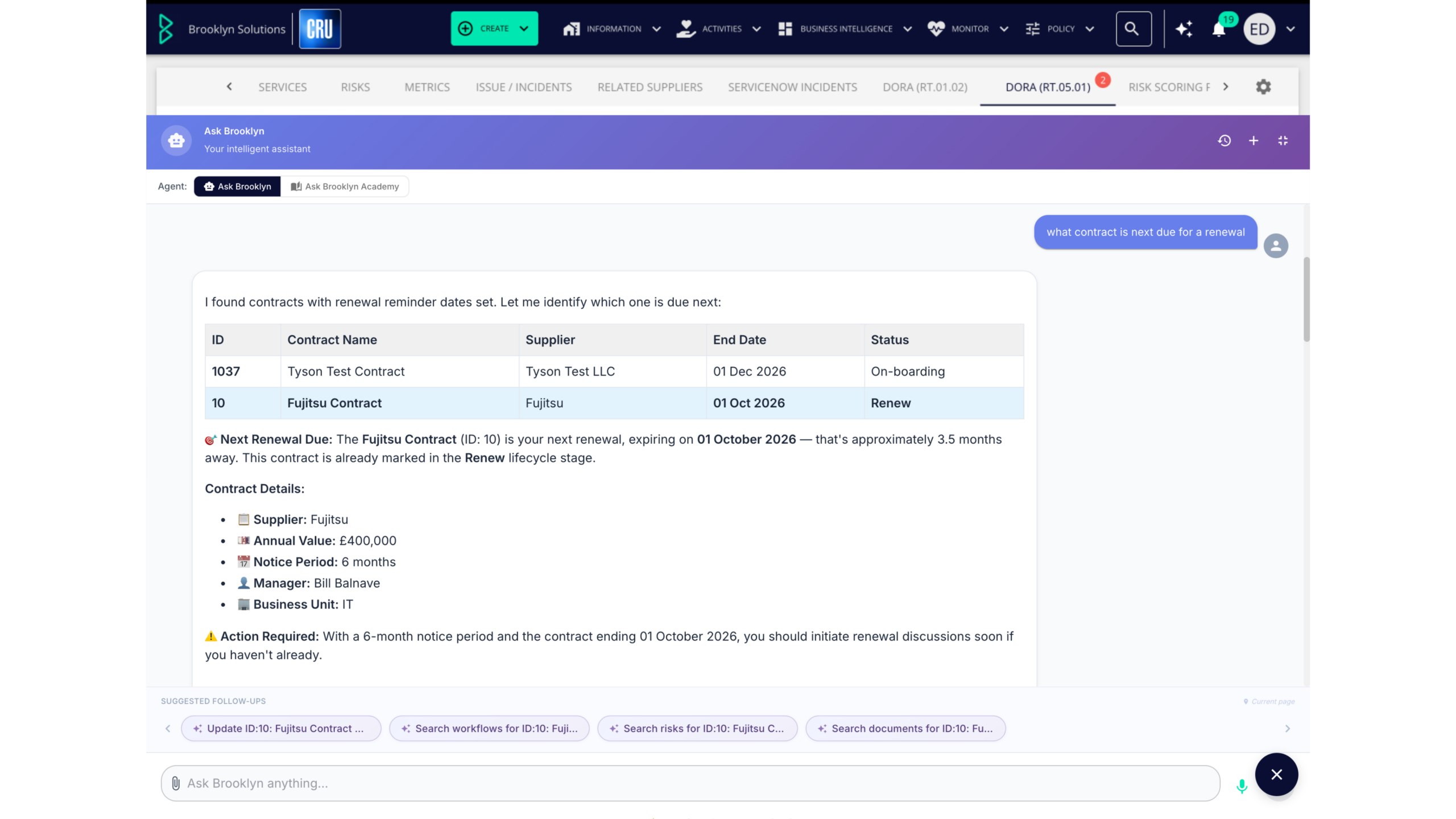
Our platform utilises RAG 2.0 (Retrieval-Augmented Generation) architecture to move beyond simple keyword searches. By employing Agentic Reasoning, the system doesn’t just find a clause; it understands the commercial context and legal intent behind it.
-
Autonomous Metadata Extraction: Using Named Entity Recognition (NER), our agents ingest multi-format contracts (PDF, Word, Email) to instantly structure data around counterparty risks, liability caps, and renewal triggers.
-
Self-Governing Compliance: Our AI agents are pre-mapped to global regulatory frameworks, including DORA, ESG (CSRD), and the EU AI Act. The system proactively flags “Above Playbook” deviations before they become audit liabilities.
-
Interoperable Intelligence: Through the Model Context Protocol (MCP), Brooklyn’s agents bridge the gap between your legal language and your operational reality, autonomously triggering workflows in your ERP and CRM systems to remediate contract leaks in real-time.
Digitally Fit-For-Audit
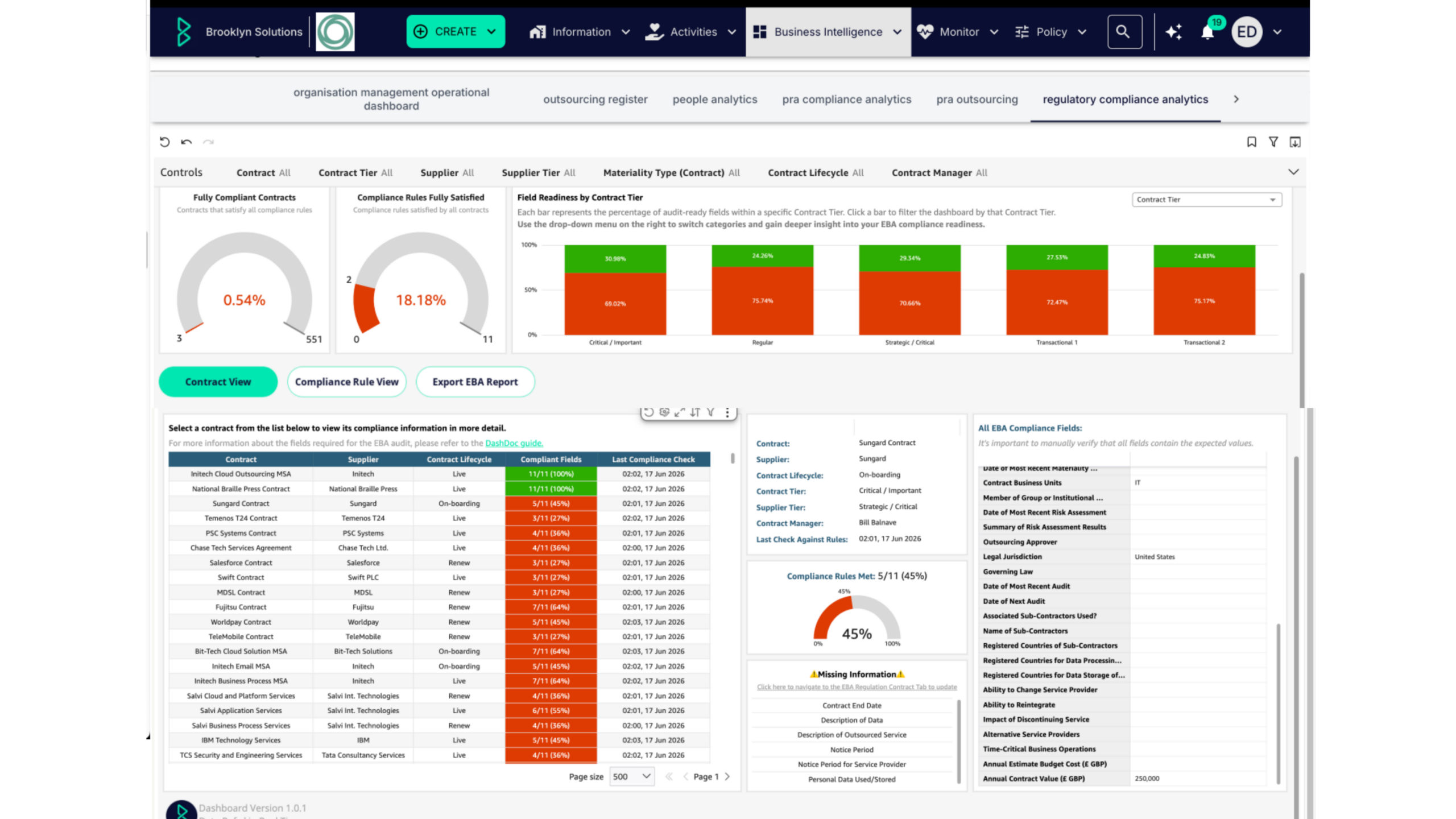
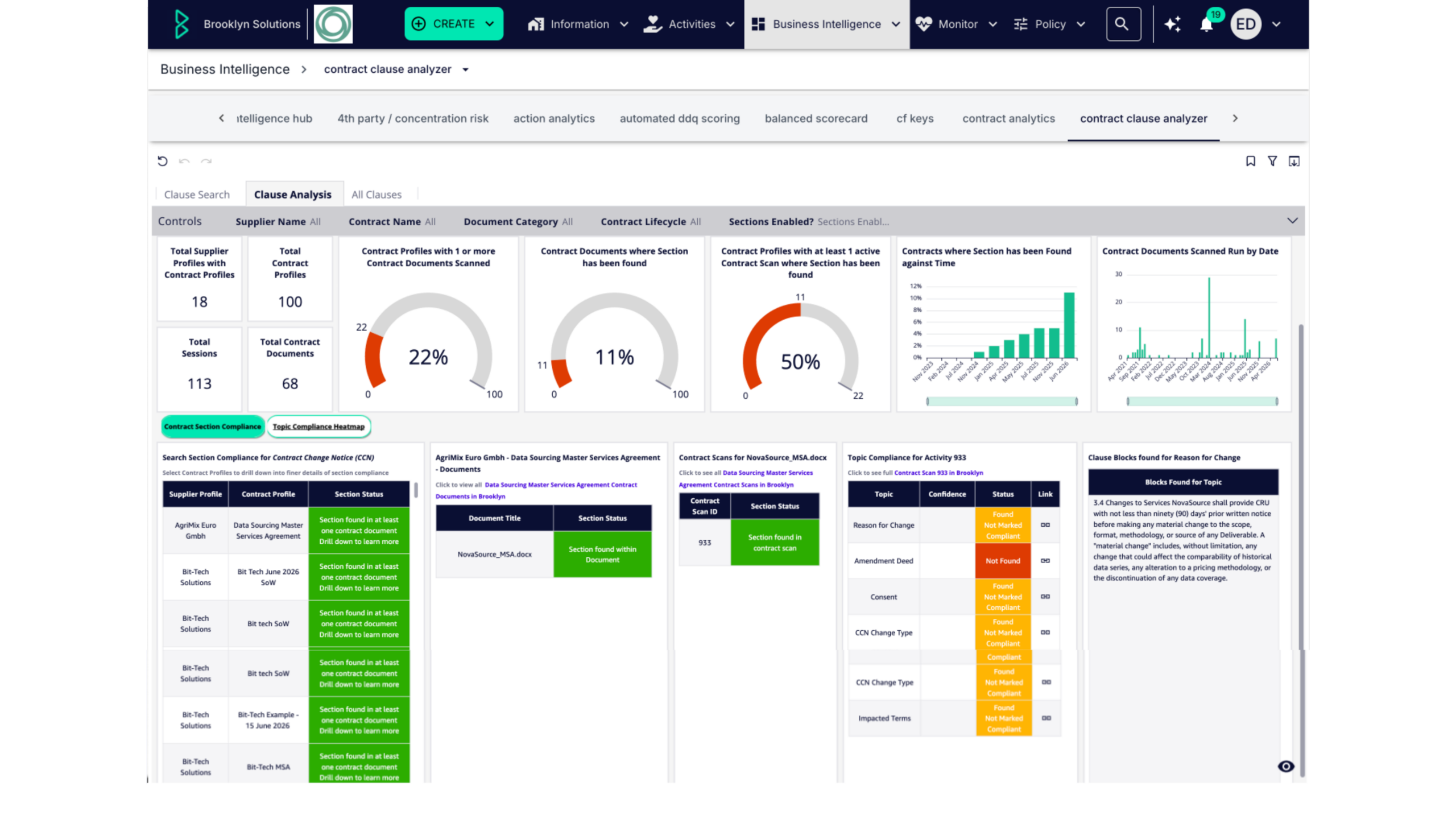
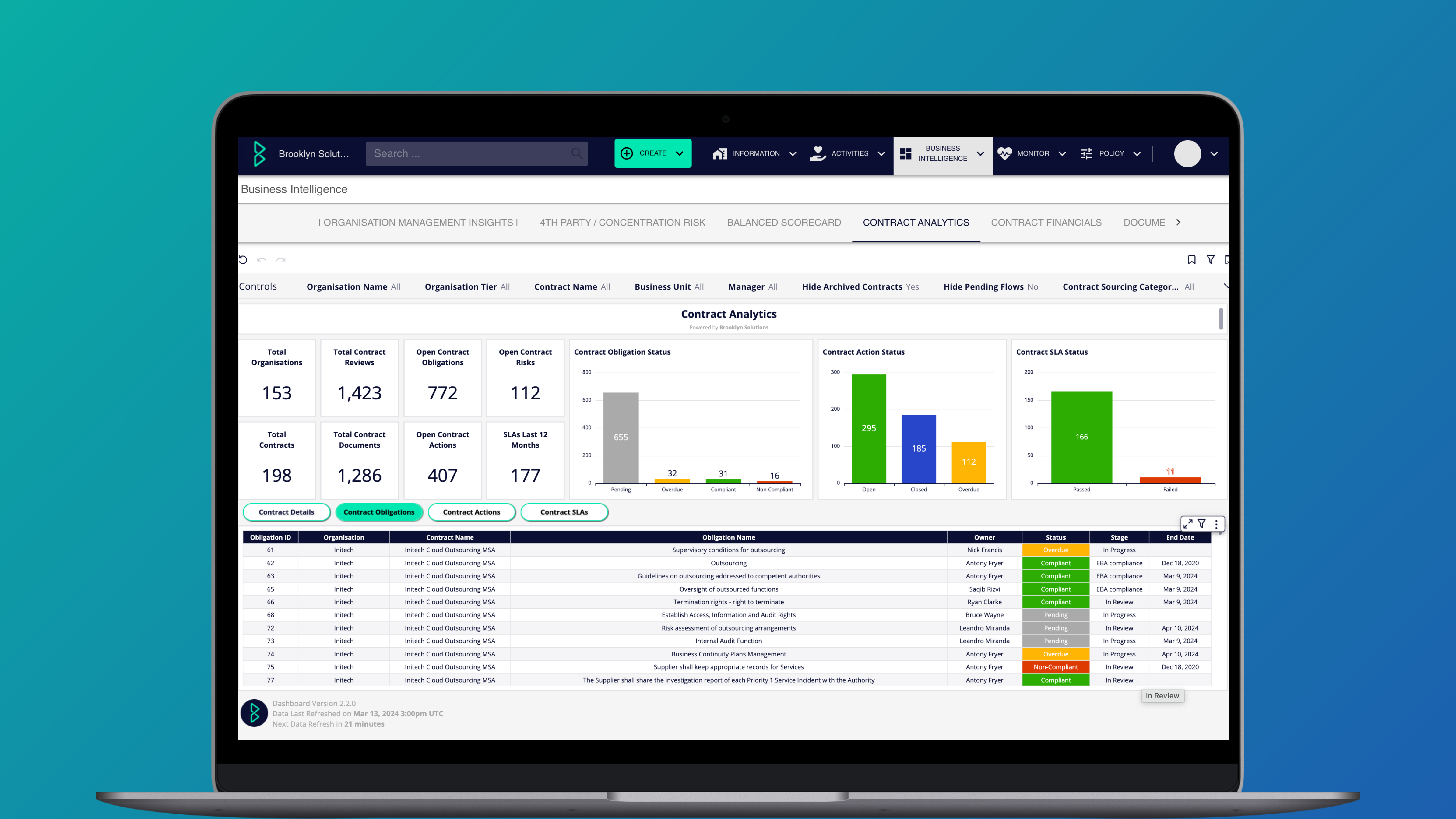
Our contract management feature provides a centralised view for assessing post-award contracts, resolving non-compliance in real-time, and ensuring adherence to company policies and external regulations like GDPR. With automated compliance checks and scoring, it streamlines workflow and ensures your digitally fit-for-audit whilst minimising risk.
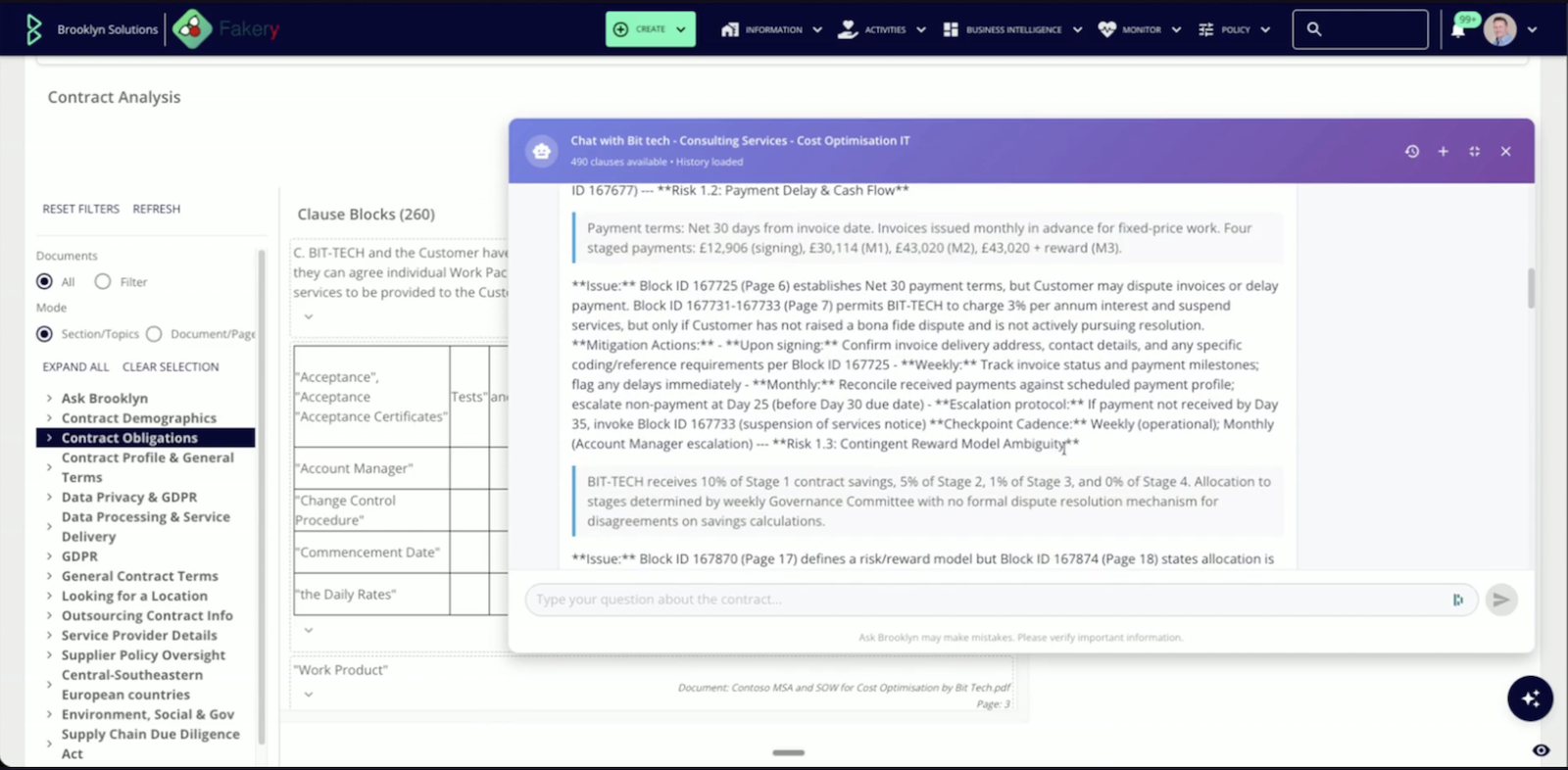
Turn static PDFs into actionable contracts with purpose. Use AI to extract obligations and SLAs directly from the contract, enabling you to standardise the contractual process to discover, operationalise and track obligations.
Reduce risk by ensuring 100% compliance with contractual obligations, leveraging insight for better contract management, through contract negotiations, reviews and renewals.
Navigating the EU AI Act with Autonomous Governance
As the EU AI Act moves into full enforcement in 2026, the burden of Algorithmic Transparency and High-Risk System classification, has shifted to the enterprise. Brooklyn Solutions acts as your frontline defence, providing the automated audit trails and Article 13 transparency reports required for compliance. Our Agentic AI doesn’t just manage contracts; it monitors your entire contract estate for AI Risk, identifying which of your vendors are utilising high-risk models and ensuring that their data processing agreements align with the latest Fundamental Rights Impact Assessment (FRIA) standards. By embedding Human-in-the-Loop (HITL) guardrails and explainable logic into every extraction, we ensure that your contract governance is not just fast, but legally defensible under the strictest global regulatory frameworks.
When CLM Becomes Essential
CLM typically becomes essential when contract volumes reach a point where manual tracking is no longer reliable, or when regulatory and audit requirements increase. At this stage, the cost of unmanaged risk and inefficiency outweighs the effort required to implement structured contract management.
For many organisations, CLM is not a matter of optimisation, but of maintaining control as complexity grows.
Frequently Asked Questions
Q: We already use DocuSign/Salesforce/Ironclad. Why do we need Brooklyn? A: Those tools are excellent for creating and signing contracts, but they are not designed to manage them. Brooklyn is a Post-Signature System of Intelligence. We pick up where your drafting tools leave off, ingesting the signed PDF to track obligations, monitor vendor performance, and ensure you actually get the value you negotiated. We don’t replace your stack; we complete it.
Q: Why shouldn’t we just store our contracts in SharePoint or OneDrive? A: SharePoint is a passive storage solution; Brooklyn is an active intelligence solution. If you store a contract in SharePoint, you have to remember to check it. In Brooklyn, the system reads the contract and alerts you to risks, upcoming renewals, and missed deliverables. SharePoint stores files; Brooklyn manages liabilities.
Q: Is Brooklyn Solutions just for the Legal team? A: No. While Legal teams love our repository, Brooklyn is primarily designed for VendorOps, Procurement, and Finance. It empowers business users to track their own vendor relationships and spend without constantly asking Legal to “find a clause.”
Q: We have thousands of legacy contracts in PDF format. Do we have to migrate them manually? A: Absolutely not. Brooklyn’s AI Ingestion Engine is capable of processing thousands of legacy PDFs (including scanned images) in bulk. Our AI extracts key metadata, dates, values, parties, and clauses, automatically, turning your “dark data” into a structured, searchable database in weeks, not months.
Q: How long does a typical implementation take? A: Because we focus on post-signature data and use AI for migration, our deployment is significantly faster than traditional CLM. Most clients achieve Initial Operating Capability (IOC) within 6-8 weeks, compared to the 12-18 month rollout cycles of heavy ERP-style CLMs.
Q: Can Brooklyn integrate with our ERP or P2P systems? A: Yes. We offer API connectors to major platforms like SAP, Oracle, Coupa, and Microsoft Dynamics. This allows Brooklyn to validate invoices against contract rate cards and ensure that spend data matches your contractual commitments.
Q: How does Brooklyn help with DORA and ESG compliance? A: Brooklyn maps your Critical Third-Party Providers (CTPPs) and their sub-outsourcing chains to visualize concentration risk. For ESG, our “Ask Brooklyn” AI can scan your entire repository to identify vendors missing mandatory sustainability clauses or modern slavery statements, generating an instant gap-analysis report for regulators.
Q: How does Agentic AI differ from traditional CLM automation? A: Traditional automation follows rigid “if/then” rules. Brooklyn’s Agentic AI uses reasoning to handle ambiguity in contract language, autonomously identifying non-standard clauses and suggesting policy-backed redlines without manual prompting.
Q: Is my contract data secure? A: Security is our baseline. Brooklyn Solutions is ISO 27001 certified and fully GDPR compliant. All data is encrypted both in transit and at rest, with granular permission controls ensuring that users only see the specific contracts relevant to their role.
Q: Can your AI ensure compliance with the EU AI Act? A: Yes. Our Governance Agents are specifically mapped to the EU AI Act and DORA frameworks, providing an automated audit trail for every AI-assisted decision made during the contract lifecycle.
Q: What is the typical ROI of implementing Post-Signature CLM? A: The World Commerce & Contracting (IACCM) estimates that companies lose 9% of annual revenue due to poor contract management. Brooklyn targets this leakage directly by:
-
Stopping unwanted auto-renewals.
-
Recovering service credits for missed SLAs.
-
Preventing price creep on invoices. Most clients see a full return on investment within 6-9 months of go-live.
Q: Can we try the platform before we buy? A: We offer a Proof of Value (POV) engagement where we ingest a sample of your actual contracts. This allows you to see your own data inside the Brooklyn platform—visualising your risks and obligations—before making a long-term commitment.
Q: We would like a digital solution, but don’t have an Enterprise budget – Brooklyn Solutions understands that moving away from PDF’s into a digital era of contract management, should be available to organisations of all sizes. That’s why we’ve created BrooklynFlex, an easy to use digital platform, that provides an Enterprise grade solution to contract lifecycle management, for smaller organisations with more defined budgetary requirements.